
A Jarring Global AI Governance Deficit: ChinaAMC’s report calls for greater AI stewardship
PR Newswire
BEIJING, July 17, 2026
A new study of tech firms reveals a major gap between high AI utilization and active risk management, calling for “Responsible AI” stewardship.
BEIJING, July 17, 2026 /PRNewswire/ — While 92% of China-listed tech companies mentioned AI-related keywords in their sustainability reports, only 22% explicitly addressed specialized AI governance, according to a latest report by China Asset Management Co. (ChinaAMC). The gap between “high AI usage” and “low AI governance discussion” is not confined to China, but is a global phenomenon that warrants attention.
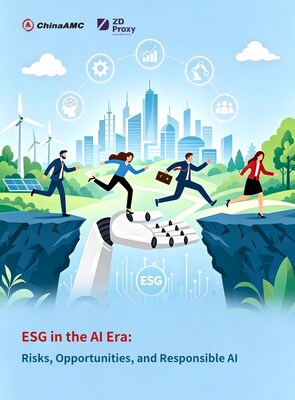
Text-mining analysis of the 2025 ESG reports of China’s STAR 50 index constituents reveals that while 49 of the 50 firms mentioned data security, privacy protection and cybersecurity, and 48 generally touched upon “science ethics”, only 11 talked about “AI ethics”, “responsible AI”,”AI risks”, according to the report jointly released by ChinaAMC and ZD Proxy, a proxy advisor firm. A parallel study by UNESCO found similar gaps globally.
This is one of several findings of the report. Launched during the high-profile World Artificial Intelligence Conference(WAIC 2026), the report echoed WAIC’s focus on “Responsible AI” and unpacked the ESG-related opportunities and risks brought about by the AI wave across the E, S, and G dimensions, with a particular focus on identifying the effective practices among enterprises, regulators, and investors. Below are our core findings:
Environmental (E): Green computing is a definitive, long-term secular trend.
Based on our observations and interviews, leading enterprises have widely incorporated the continuous optimization of computing energy efficiency into their client contracts as a hard requirement. Green computing is shifting from a “nice-to-have” benefit to a mandatory “barrier to entry.” Although still in its infancy, the direction of this trend is certain, offering long-term structural opportunities for the industry.
Social (S): Large-scale job restructuring rather than sheer displacement.
Certain roles are indeed disappearing—particularly technical, entry-level positions. A report by Anthropic revealed that for jobs highly exposed to AI, entry rates for young professionals aged 22–25 dropped by more than 10% relative to 2022 levels, while their counterparts over 25 saw no equivalent change.”
However, other studies found client-facing capabilities, domain-specific know-how embedded in actual workflows, and interpersonal people skills remain difficult to replace. In these areas, AI acts more as an enhancer than a replacement. Furthermore, we find that the actual consequences of this social transition are not dictated solely by the technical boundaries of AI; corporate strategic attitudes play an equally vital role. When enterprises position AI as a “multiplier of employee capabilities,” they can effectively drive workforce empowerment and job restructuring, achieving a long-term win-win for labor value.
Governance (G): Most enterprises prioritize application over governance, while regulatory frameworks are taking shape.
Text-mining analysis of the 2025 ESG reports of STAR 50 index constituents reveals that while 92% mentioned AI-related keywords, only 22% explicitly addressed specialized AI governance. This gap—characterized by “high AI usage, low governance discussion—reflects a current governance deficit.
Meanwhile, the world’s three major economies have carved out three distinct regulatory pathways: China balances development with security through agile legislation and rapid iteration; the European Union has built a stringent regulatory framework centered on risk classification; and the United States is experiencing a tug-of-war between federal deregulation and tightening state-level oversight.
Investor Action: “Responsible AI” is evolving from a niche pioneer initiative into a quantifiable, comparable stewardship agenda.
AI-related shareholder proposals continue to surge in the U.S. stock market, and investor attention is shifting toward addressing specific gaps in corporate governance structures. The number of AI-related shareholder proposals rose from 16 in 2023 to 26 in 2025. These AI governance resolutions garnered an average of approximately 30% support from independent shareholders, compared with 16% average support for general environmental and social proposals over the same period.
“Ultimately, we believe that the true impact of AI on ESG depends entirely on how the technology is designed, deployed, and governed,” said Shirley Xu, ESG research head of ChinaAMC. “ChinaAMC is actively building a ‘Responsible AI’ evaluation framework, systematically assessing tech companies from their governance structure, risk identification and assessment, and positive externalities.”
About ChinaAMC:
Founded in April 1998, China Asset Management Co., Ltd. (ChinaAMC) has grown to be one of the largest asset managers in China, with total AUM reaching RMB3.15 trillion (US$465.3 billion, including subsidiaries) as of the end of June 2026. It positioned itself as a full-service and versatile asset management platform that operates across asset classes, industries and regions. In 2017, it became the first full-service asset manager to sign the UN PRI in China. Since then it has conducted over 170 deep engagements with more than 70 Chinese companies. It attended more than 1,000 shareholder meetings in 2025 alone.
Disclaimer
Investment involves risk, including possible loss of principal. The information contained herein is for reference only and reflects prevailing market conditions and our judgment as of the release date, which are subject to change without further notice.
 View original content to download multimedia:https://www.prnewswire.com/news-releases/a-jarring-global-ai-governance-deficit-chinaamcs-report-calls-for-greater-ai-stewardship-302828306.html
SOURCE ChinaAMC


