LUOYANG, China, Aug. 06, 2026 (GLOBE NEWSWIRE) — TRUNNANO, a leader in the advanced ceramic materials sector, has announced the official release of a comprehensive selection guide covering 12 types of ceramic crucible materials. The guide systematically maps the performance boundaries and application scenarios of mainstream crucible materials including alumina, silicon carbide, silicon nitride, boron nitride, zirconia, and graphite. It is designed to provide engineers and procurement professionals in the semiconductor, metallurgy, and new energy industries with a scientific material-selection methodology that spans from “operating conditions” to “total cost of ownership.”
As standard vessels in high-temperature processing, ceramic crucibles directly determine product purity, production efficiency, and process stability. In practice, however, many users fall into the trap of focusing solely on temperature ratings or comparing only purchase prices—leading to premature crucible failure, melt contamination, or runaway costs. TRUNNANO’s newly released selection guide addresses these industry pain points by building a complete decision-making framework based on three core usage conditions—temperature, atmosphere, and melt—while also incorporating life-cycle factors such as thermal cycling frequency and mechanical durability.
Selection Guide Tackles Three Core Material-Selection Challenges
During the compilation of the guide, the TRUNNANO technical team drew on over 12 years of application data to systematically address three common cognitive blind spots in ceramic crucible selection.
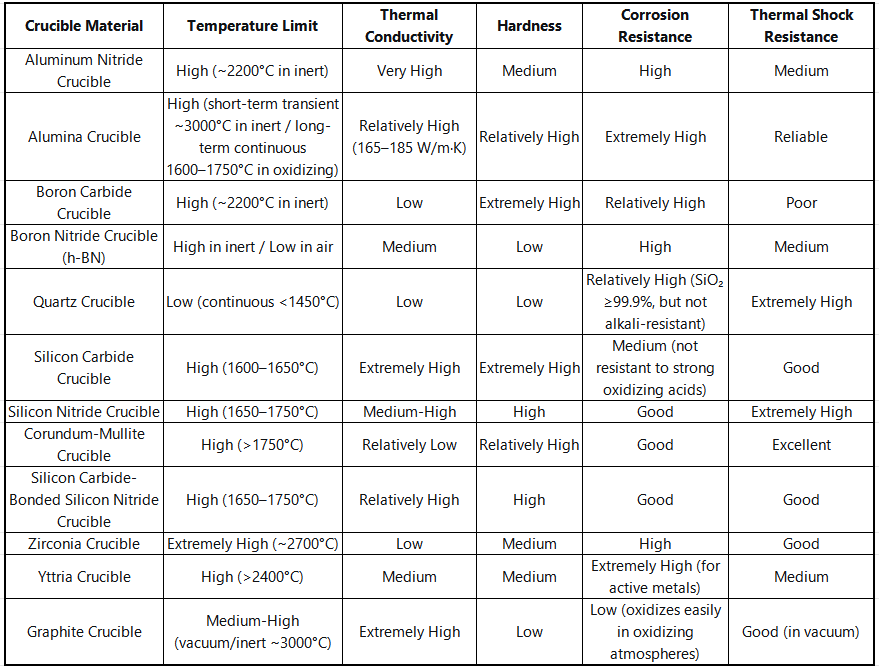
Comparison of 12 Material Ceramic Crucibles
1. Clarified the critical distinction between “maximum withstand temperature” and “long-term safe operating temperature.”
The guide clearly states that alumina crucibles can withstand transient thermal shocks approaching 3000°C in inert atmospheres for short durations, but long-term continuous use must be kept below 1600–1750°C. By contrast, zirconia crucibles can reach approximately 2700°C under specific conditions, making them the benchmark for precious metal smelting. The nearly 1000°C gap between these two figures represents the difference between “withstanding a momentary spike” and “lasting a full year of service.” By precisely defining the thermal performance boundaries of each material, TRUNNANO helps users avoid premature failures caused by misinterpretation of temperature ratings.
2. Established a “triple-matching” selection logic covering temperature, atmosphere, and melt.
Atmosphere conditions determine a crucible material’s “survivability.” Boron carbide and boron nitride crucibles oxidize at high temperatures in air; graphite crucibles are susceptible to oxidation in oxidizing atmospheres but perform excellently in vacuum and inert environments—the same material may be either fully suitable or completely unusable depending on the atmosphere. Melt compatibility is equally critical: alumina crucibles are incompatible with strong alkalis; quartz crucibles are not alkali-resistant; yttria crucibles exhibit exceptional chemical inertness toward active metals such as titanium. The guide emphasizes that temperature limit, atmosphere compatibility, and melt compatibility must be satisfied simultaneously—neglecting any one of these constitutes a potential risk.
3. Incorporated “purity grade” as a core variable in the selection system.
The same crucible material often comes in different purity grades, which directly affect high-temperature performance and contamination resistance. Taking alumina crucibles as an example: 95% alumina is suitable for general-purpose smelting; 99% alumina offers improved high-temperature strength and creep resistance for more demanding processes; 99.5% or higher ultra-high-purity alumina is used in semiconductor and optical glass applications where contamination sensitivity is extremely high. Quartz crucibles also have a grading system—solar-grade quartz requires a purity of approximately 99.99%, while semiconductor-grade quartz inner layers must reach 99.998% or higher. The key to selection lies in matching the purity grade to process requirements, rather than blindly pursuing “maximum purity.”
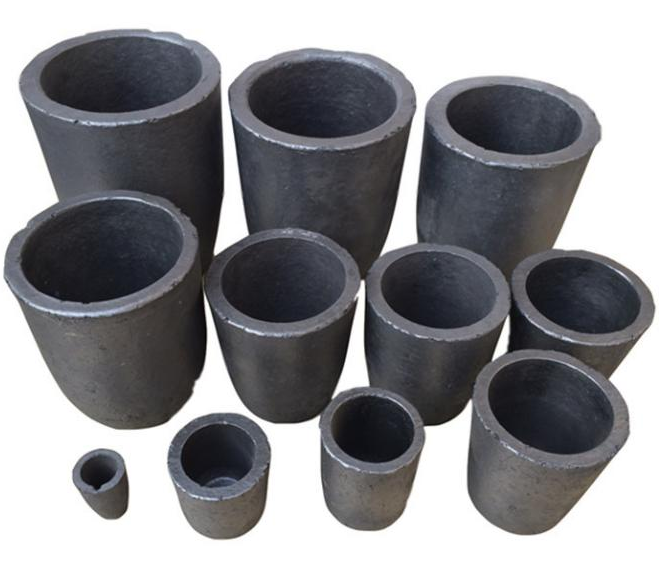
Reaction Sintered Silicon Carbide Ceramic Crucibles
Roger Luo, CEO of TRUNNANO, stated: “In high-temperature processes, the crucible is not merely a container—it is a critical factor that determines product purity and process success. We remain committed to a customer-centric approach, helping clients avoid risks at the source and achieve cost reduction and efficiency gains through systematic selection guidance. This guide distills our years of engineering data and industry experience across 12 core ceramic materials, with the goal of providing global customers with actionable material-selection references.”
From “Material Choice” to “Cost Reduction”: A Total-Cost-of-Ownership Selection Strategy
The guide also introduces the concept of “Total Cost of Ownership” (TCO) in material selection, emphasizing that purchase price is not the full cost. Low-cost crucibles often lead to higher replacement frequency, greater furnace downtime, and increased cleaning labor—costs that frequently exceed the purchase price itself. The correct approach is: Purchase Cost + Maintenance Cost + Consumption Cost + Shutdown Risk Cost = True Cost.
In precious metal smelting, crucible contamination can scrap an entire melt, with losses far exceeding the crucible’s own price. The higher the purity requirements, the greater the weighting that “contamination resistance” should carry in the selection process. In many cases, choosing a slightly more expensive but higher-purity crucible proves more economical than a cheaper alternative—because it avoids the cost of a single contamination incident.
Additionally, the guide provides a detailed analysis of common ceramic crucible failure modes—cracking, spalling, perforation, sticking, and premature failure syndrome—along with systematic countermeasures for each failure type, ranging from material adjustments to operational optimizations. This equips users to quickly diagnose root causes and adjust selection strategies when problems arise.
About TRUNNANO
TRUNNANO is a high-tech enterprise dedicated to the research, development, production, and sales of nanomaterials, high-end ceramic products, and high-purity chemicals. Driven by technological innovation, the company’s products are widely applied across diverse sectors, including electronics, new energy, thermal management, and industrial catalysis. Renowned for its exceptional product quality and professional technical services, TRUNNANO has earned the widespread trust of customers worldwide. Under the leadership of CEO Roger Luo, TRUNNANO will continue to drive advancements in materials science, leveraging continuous technological breakthroughs to contribute to global industrial development.
Media Contact: Roger Luo
Email: nanotrun@yahoo.com / sales8@nanotrun.com
Phone/WhatsApp: 0086 18837956556
Photos accompanying this announcement are available at https://www.globenewswire.com/NewsRoom/AttachmentNg/46b8bc93-70a7-467e-b0f9-be0e47fbf18d
https://www.globenewswire.com/NewsRoom/AttachmentNg/ac94e130-83d7-4b02-9e3a-5d2740efc997